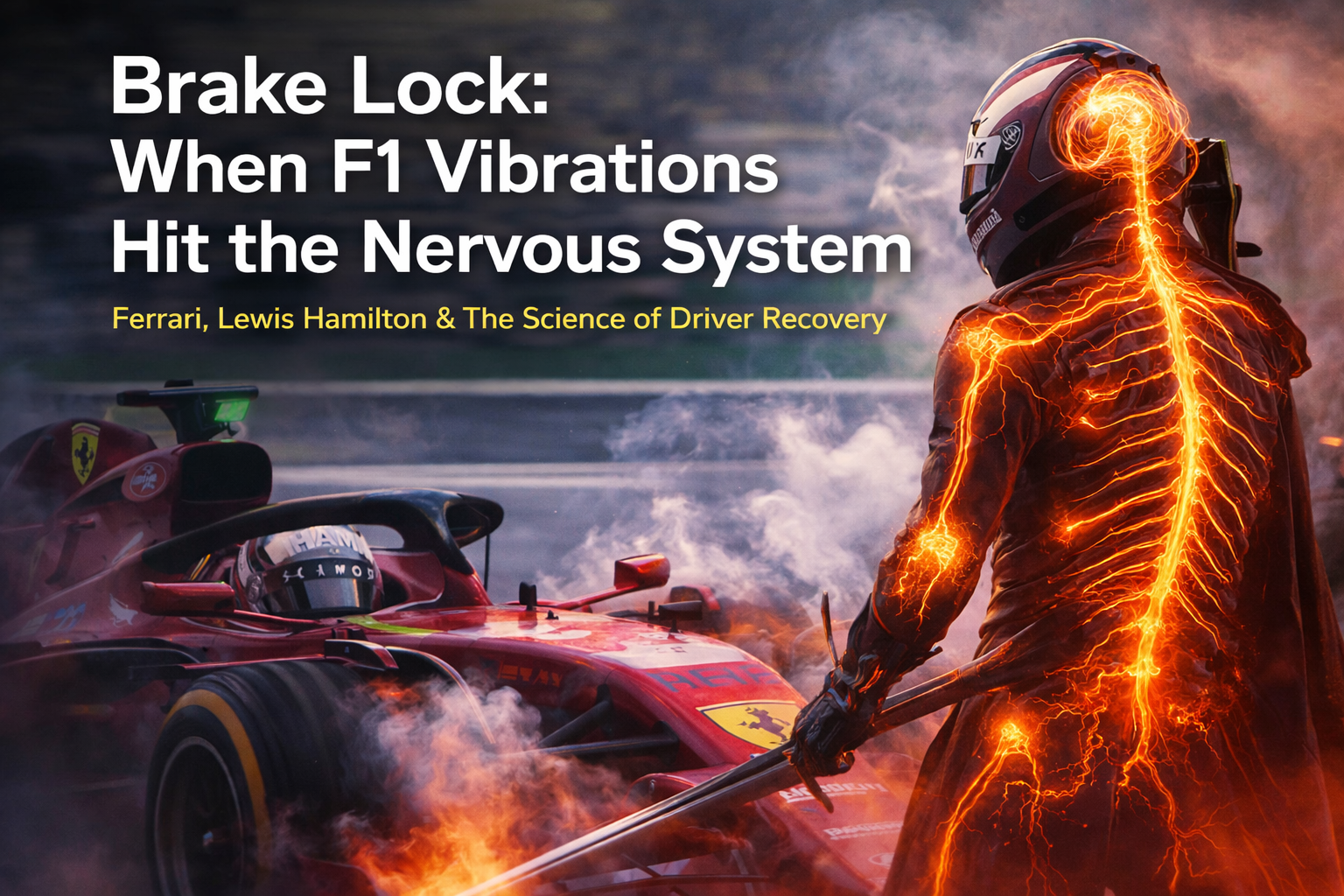
When a Formula 1 driver brakes from over 320 km/h into a corner, the forces on the human body are extreme. Drivers experience braking loads of 5G or more, meaning their body suddenly weighs five times its normal weight.
But when a brake lock-up occurs, the stress becomes even more intense.
A brake lock happens when a wheel stops rotating under heavy braking and begins to slide across the track surface. Instead of rolling smoothly, the tire skids violently, sending powerful vibrations through the car’s chassis, steering wheel, and pedals.
For the driver, those vibrations travel directly through the body.
The hands and arms absorb the shock through the steering wheel, while the legs and feet feel the intense feedback through the brake pedal. In severe cases, the vibration can travel through the nervous system, creating physical fatigue and strain over the course of a race weekend.
Modern Formula 1 cars use advanced systems like Brake-by-Wire (BBW) to help control rear braking and maintain balance between the front and rear axles. But even with these systems, sudden changes in braking load or track conditions can still cause lock-ups.
Inside Merlins F-Labs, the science of performance and recovery is studied from the athlete’s perspective. Mikaela and Krishma explore how drivers manage the physical effects of these forces and how recovery technology may support the body after extreme vibration and G-loads.
From innovations like Merlins Guard, designed to stabilize the jaw and nervous system, to advanced peptide recovery pens developed in EU-GMP laboratories for precision dosing, Merlins F-Labs looks at how science can help modern athletes maintain balance, focus, and recovery under extreme conditions.
In Formula 1, the margin between success and failure is often measured in milliseconds.
Understanding the science of the human body behind the wheel may be the next great performance edge.